Mission Statement
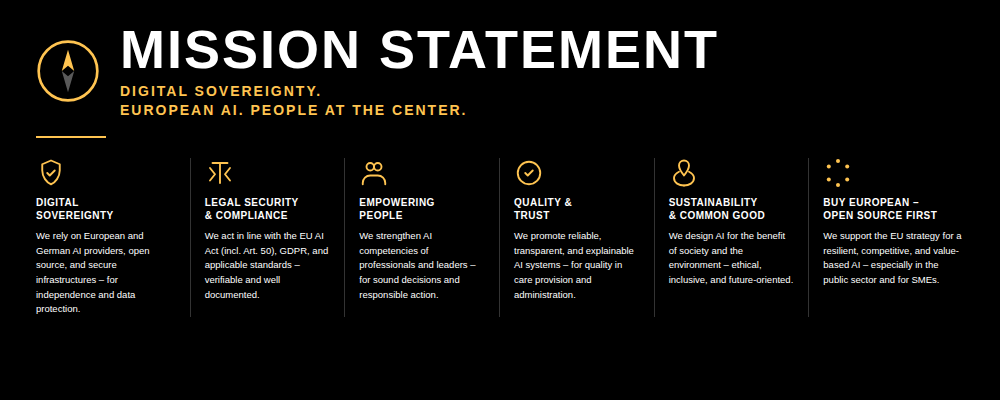
Responsible AI qualification for healthcare, care, the social economy and municipal public services based on European and German AI technologies – in line with the Apply AI Strategy of the European Commission and the EU AI Act.
Sovereignty as a guiding principle of qualification
The digital transformation of the social economy is increasingly shaped by the use of artificial intelligence. In development, testing and implementation of AI qualification measures, this initiative aims to give priority to European and especially German AI providers, platforms and digital infrastructures.
This ensures that data sovereignty, transparency, European values and the requirements of the EU AI Act are taken into account from the outset. At the same time, the innovative strength of the European AI ecosystem is to be reinforced and dependencies on non-European technology providers reduced.
Three guiding objectives
- Safeguard data sovereignty & transparency
- Strengthen the European AI ecosystem
- Reduce dependencies on non-European providers
Alignment with the European Commission’s Apply AI Strategy
The qualification strategy aims to enable employees in healthcare, care, the social economy and municipal public services to use artificial intelligence competently, critically and responsibly. The focus is not on the use of individual technologies, but on building sustainable operational competence. Staff should learn to assess AI systems from a professional perspective, classify risks and opportunities, take legal requirements into account and select suitable solutions for their specific work context.
This orientation is aligned with the European Commission’s “Apply AI Strategy”. The strategy pursues an “AI-first” policy and promotes a “Buy European” approach, especially for the public sector and small and medium-sized enterprises, with a focus on open-source AI solutions.
A particular focus is placed on the ability to identify European and especially German AI providers, language models and digital platforms, compare them with one another and evaluate their suitability for practical use. To this end, the qualification does not only provide basic technical knowledge, but also builds competence in data protection, information security, AI governance, transparency, documentation, procurement and organisational responsibility.
In the long term, this is intended to create a sustainable and independent AI competence structure that enables organisations to evaluate technological developments autonomously and make strategic decisions on a sound basis. The aim is to reduce dependencies on individual non-European platform providers, strengthen digital sovereignty and make innovation usable in a responsible manner.
Buy European – Open Source First
AI-first policy of the European Commission with a focus on the public sector, SMEs and key sectors – healthcare and care are explicitly included.
Competence instead of technology focus
The focus is on the people working with AI – not on the technology itself. Employees are enabled to select and use European systems responsibly.
Values embedded in AI qualification
Transparency
Traceable AI systems and clear labelling of AI-generated content in accordance with Article 50 of the AI Act.
Data Protection
Data sovereignty and GDPR compliance as core prerequisites for use in healthcare and social services.
Participation
Involvement of employees and representative bodies in the selection and design of AI applications.
European Values
Alignment with European fundamental rights, the EU AI Act and the Buy European logic of the Apply AI Strategy.
Voluntary Commitments
Voluntary commitments and reference documents for implementing the transparency obligations of the EU AI Act form a central basis for teaching responsible AI use in the qualification modules.
On 12 June 2026, Thomas Bade signed the voluntary commitment to theCode of Practice on Marking and Labelling of AI-generated Contentof the European AI Office. The code of practice was published by the European Commission to support organisations in the practical implementation of the transparency requirements under Article 50 of the EU AI Act.
By signing, Thomas-Bade commits in particular to:
- transparently and traceably labelling AI-generated content,
- integrating the requirements of the EU AI Act into qualification and governance concepts at an early stage,
- documenting the origin and creation of digital content in a traceable manner,
- raising awareness among employees, managers and organisations of the transparency obligations under Article 50 of the EU AI Act,
- promoting trustworthy, explainable and responsibly deployed AI systems,
- actively supporting European standards for digital sovereignty, data protection and information integrity.
“AI literacy, transparency and digital sovereignty belong together. Where AI content is created or edited, its origin, responsibilities and the use of AI should remain traceable for users.”Voluntary Commitment Thomas-Bade · 12 June 2026
Code of Conduct “Democratic AI”
Thomas Bade has signed the Code of Conduct Democratic AI and thereby supports the initiative for the responsible, human-centred and public-interest-oriented use of artificial intelligence.
The code of conduct was developed together with more than 50 civil society organisations and serves as a voluntary commitment for organisations that want to use AI in line with democratic values. Its aim is to make the use of AI transparent, traceable, discrimination-sensitive and socially responsible.
The principles of the Code of Conduct will gradually be integrated into the qualification programmes, governance tools, checklists, learning modules and advisory services. The aim is to support organisations in healthcare, care, the social economy and municipal public services in using AI responsibly, transparently and in line with European values.
Human-Centred Design
AI supports people in decision-making and does not replace responsibility, professional expertise or participation.
Transparency
AI systems and AI-generated content should be labelled in a traceable and understandable manner.
Inclusion
Employees, volunteers and affected stakeholders are involved in the introduction and evaluation of AI systems.
Responsibility
AI governance, competence-building and clear responsibilities are prerequisites for responsible deployment.
“AI should strengthen freedom, justice and solidarity and not undermine them.”Guidance based on the Code of Conduct Democratic AI
Integration into the ESF+ Qualification Strategy
This mission statement forms the professional and value-oriented foundation of the ESF+ initiative “AI Qualification for Employees in the Health and Care Sector” (Calls 8 and 9, Funding Action 12 “Social Innovation”). Digital sovereignty is not an additional topic here, but an integral part of all learning paths, checklists and module curricula.
Data sovereignty, transparency, European values and the requirements of the EU AI Act are considered from the outset – European solutions are given preferred consideration.Mission Statement AI Qualification · thomas-bade.de, June 2026
Become a Partner
Institutions, providers and companies can submit an expression of interest by 15 June 2026.
Go to the ESF+ Partner Call